TL;DR
- Casio LED-10 launched in the early 1990s, with a confirmed release in January 1993.
- Dual lighting system: internal LCD backlight plus an LED integrated into the crystal.
- 1/1000-second stopwatch and advanced timers, including multi-stopwatch and four independent countdowns.
- Now rare with grail colors (Red, Green, Yellow). Black with gold accents is the most common.
- Module 1026 with a dedicated “sports multitimer, lap split memory” strap that is hard to replace.
Casio LED-10 – Technical Data & Model Information
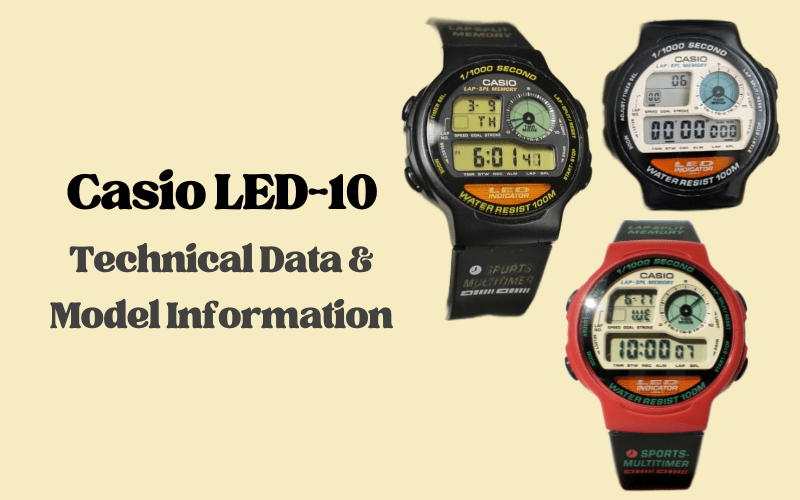
Casio LED-10 is a digital wristwatch released in the early 1990s, with a confirmed launch in January 1993. It was the first model in Casio’s LED family and introduced a dual-lighting system combining a conventional LCD display with an internal backlight and a dedicated external LED indicator integrated into the module. The LED provided visual alerts for alarms, countdown timers, and time signals, forming the core concept later continued by its direct successor, the Casio LED-20.
At launch, the LED-10 occupied Casio’s mid-priced range at approximately £40 in the UK. In addition to its lighting system, the watch offered advanced timing functions for the period, including a 1/1000-second stopwatch with lap and split memory, speed and estimated time of arrival calculations, stroke rate measurement, and a four-timer countdown system with patterned alerts and a circular visual display.
Quick Technical Data
| Parameter | Value |
|---|---|
| Model name | Casio LED-10 |
| Module number | 1026 |
| Production years | 1993–1994 |
| Manual | Casio LED-10 / Module 1026 manual (PDF) |
| Battery | CR2016 |
| Glass Type | Acrylic |
| Strap Lug Width | 17 mm |
| Strap Case Width | 21 mm |
| Color Versions |
Black Case with Gold Accents; Black Case with White Dial; Red Case Version; Yellow Case Version; Green Case Version; |
| Special / unique features | LED integrated into the crystal; dual lighting system (LCD backlight + external LED indicator); 1/1000-second stopwatch with 9-lap/split memory and auto display change; multi-stopwatch with speed (km/h or mph), estimated finish time, and stroke rate; four independent countdown timers with analog-style visual countdown and smart alerts; silent alarm (LED-only); calendar without year setting that never expires; dedicated strap with “sports multitimer, lap split memory” lettering. |
Color Versions
Black Case with Gold Accents
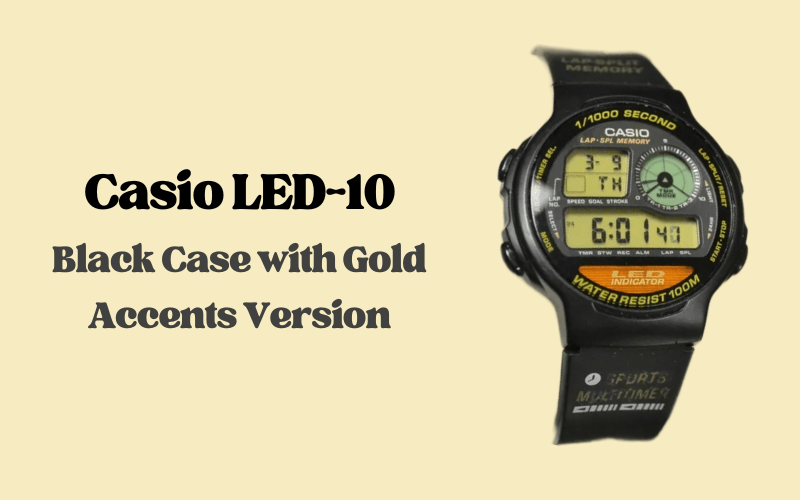
The Casio LED-10 in this version has a black case with matching black bezel, black buttons, and gold/yellow printed text and accents on the dial and bezel. Rarity: common.
Black Case with White Dial
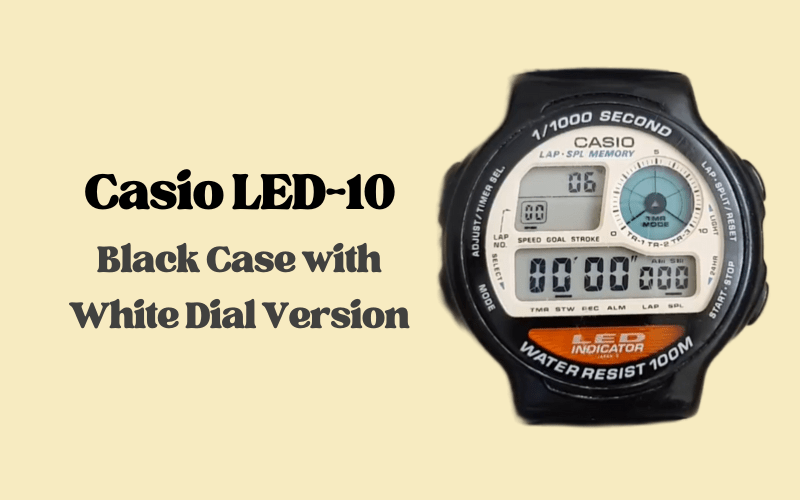
Black case with black bezel, black buttons, and a light/white dial background with darker contrasting text. Rarity: rare.
Red Case Version
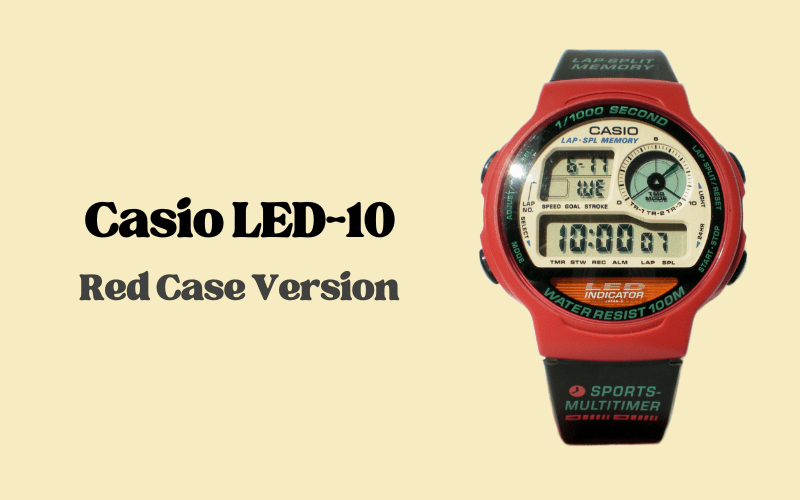
Red case with black bezel, black buttons, and a high-contrast dial with dark text and colored accents. Rarity: grail.
Yellow Case Version
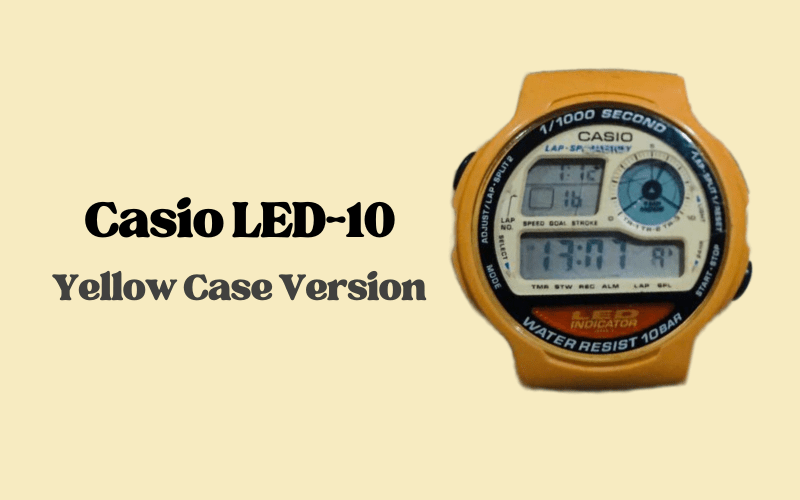
Yellow case with black bezel, black buttons, and a light dial with dark text and colored accent markings. Rarity: grail and rarest.
Green Case Version
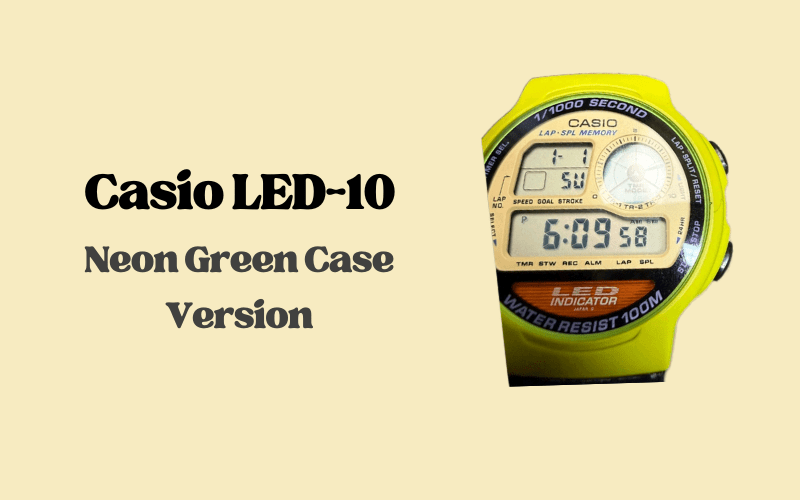
Bright green case with purple letters on the bezel, black buttons, and a light dial with dark text and colored accent markings. Rarity: grail and rarest.
How do the functions and modes work on the Casio LED-10?
Casio LED-10 offers distinct modes for timing and alerts.
- Timekeeping mode shows time in 12 or 24 hours. The calendar shows month and day.
- Stopwatch mode measures to 1/1000 second for high-precision timing.
- Lap and split timing records racing intervals and comparisons.
- Memory stores nine lap/split records plus the final stop time. The oldest record auto-deletes when full.
- A 10-second pre-countdown can run before timing starts.
- The display format switches automatically on long durations. It changes from mm:ss:1/1000 to hh:mm:ss.
- Multi-stopwatch mode measures speed in km/h or mph after you set a lap distance.
- Estimated finish time calculates from lap distance and total race distance.
- Stroke calculation outputs repetitions per minute for cadence or strokes.
- Countdown timer system has four independent timers for short or long intervals.
- The round display shows an analog-style countdown for quick visual progress.
- Smart alerts beep and flash at set intervals, with a 10-second alarm at zero.
- Alarm mode includes a daily alarm, an hourly signal, and a silent option using the LED only.
Casio LED-10 Manual
The official Casio LED-10 manual for module 1026 is available on the CasioRestore.com drive:
Casio LED-10 / Module 1026 manual (PDF)
Display of the Casio LED-10
Casio LED-10 uses a three-window layout for fast reading.
- Three-window top layout groups key data at a glance.
- Two square digital windows show the main numerics.
- A round graphic display acts as a seconds and progress indicator.
- The round display updates every 5 seconds.
- The round graphic shows stopwatch and timer progress clearly.
- Gold-tone display and lettering deliver a premium 90s aesthetic.
- The integrated LED is built into the crystal for a seamless look.
- Dual lighting works during alarms and signals for instant feedback.
What are the physical design details of the Casio LED-10?
Casio LED-10 mixes bold colors with practical hardware choices.
- Case color options match the known color versions, including black/gold, black/white dial, red, and green/yellow.
- Black buttons appear on all versions.
- Acrylic glass is used for the crystal.
- The dedicated strap has printed “sports multitimer, lap split memory” lettering.
- A built-in speaker provides sound, though it can fail with age.
- The LED is integrated into the crystal for a clean, unified design language.
Strap & fit of the Casio LED-10
Casio LED-10 uses a model-specific strap that affects fit and replacements.
- Dedicated strap with “sports multitimer, lap split memory” lettering.
- Model-specific strap compatibility limits easy swaps.
- Original resin straps are prone to degradation over time.
- Finding replacement straps in the original style is difficult.
What are the known issues and limitations of the Casio LED-10?
Casio LED-10 has a few age-related caveats to consider.
- No year setting in the calendar, only month and day.
- Original resin straps often degrade.
- Original-style strap replacements are hard to source.
- Speaker failure is common in surviving units.
- Battery drain risk increases if the LED test mode is left on too long.
- The advanced stopwatch system adds maintenance complexity.
Collector notes of the Casio LED-10
The Casio LED-10 shows strong collector demand, with a clear hierarchy of colors and configurations. It is currently rare and expensive on the secondary market, driven by a strong nostalgia factor among original owners.
Based on long-term collector observations, black is the most commonly seen version, followed by the black case with white dial, which is notably rarer. Red is widely considered a grail color, while green and yellow sit at the top of the rarity scale and are regarded as the rarest variants. Black with gold accents appears most frequently in surviving examples.
Rarity and value depend heavily on originality and condition, with one often overlooked factor being the original strap. The LED-10 was sold with a model-specific resin strap marked “SPORTS MULTITIMER / LAP SPLIT MEMORY.” Examples retaining this strap are harder to find and more desirable among collectors, as many watches lost it over time or were fitted with generic replacements.
Successors and related models of the Casio LED-10
Casio LED-10 sits in the LED family alongside the LED-20 and LED-30.
- Part of the LED series: LED-10, LED-20, LED-30.
- LED-10 is widely regarded as the most iconic of the series.
What are the key facts of the Casio LED-10?
Casio LED-10 quick-reference highlights:
- Module: 1026.
- Battery type: CR2016.
- Stopwatch resolution: 1/1000 second.
- Countdown timer resolution: 1/10 second.
- Lap/split memory: nine records plus final stop with auto-delete.
- Four independent countdown timers.
- Dual lighting with an external LED indicator.
- Silent alarm via LED flash.
- Round graphic display updates every five seconds.
- Calendar without year, so it never expires.
- Black buttons across all versions.
- Release timeframe often cited as 1993–1994.
FAQ – Casio LED-10
What year was the Casio LED-10 released?
Casio LED-10 launched in January 1993, with the production period commonly cited as 1993–1994.
What battery does the Casio LED-10 use?
It uses a CR2016 lithium coin cell as specified for Module 1026.
How precise is the stopwatch on the Casio LED-10?
The stopwatch resolution is 1/1000 second, with lap/split memory for race timing. The display automatically switches format for long durations.
Does the calendar on the Casio LED-10 ever expire?
No. The calendar shows month and day only, with no year setting, so it never expires.
What are the color versions of the Casio LED-10?
Documented versions include black with gold accents, black with white dial, red, and bright green/yellow. Collectors rank black/gold as most common, white-dial as rare, red as a grail, and green/yellow as the rarest.
Sources & Research Notes
The information needed to write this article about Casio LED-10 was gathered through hands-on research for CasioRestore.com. Sources include vintage Casio catalogs, Japanese blogs and archives (google.co.jp), old brochures, printed manuals, direct examination of real watches, and knowledge shared through conversations with collectors on Reddit, FB groups, and in private discussions.

Daniel is the person behind Vintage Casio Restore, a project dedicated to restoring and documenting vintage Casio digital watches from the 80s and 90s. Based in Poland, he combines technical precision with a passion for retro design, bringing forgotten models back to life and sharing their stories online.Outside the workshop, Daniel works in a digital agency, managing SEO and content strategy for technology clients, blending his professional experience with his love for classic tech and design.
Leave a Reply