
TLDR
- The Casio JG-100 was released in January 1995 targeting teenagers and tech/game enthusiasts.
- Its main unique feature is infrared communication combined with built-in gaming.
- Key functions include a 10-page databank and remote control for TVs and VTRs (on JDM models only).
- The watch features a large, chunky design with 11 buttons arranged for mode control, gaming, and IR transmission.
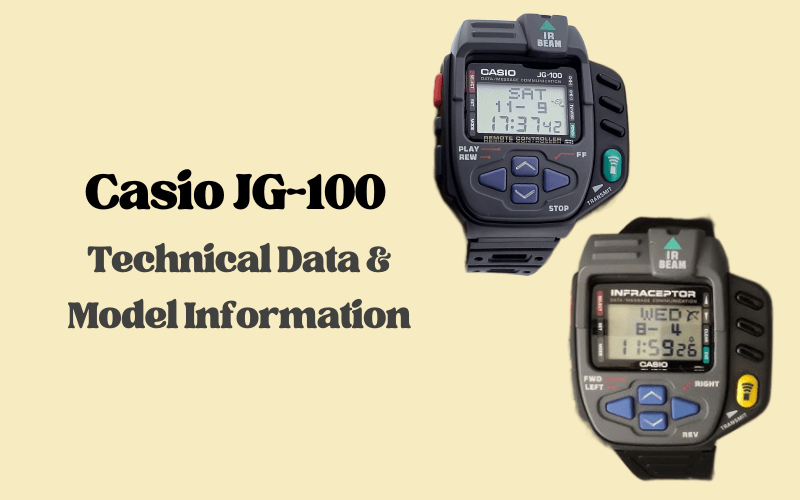
- There are two color variants differing in button colors and labeling: the Purple-Arrow Version and the Blue-Arrow Version (Infraceptor).
Fast Navigation
- Short answer: Casio JG-100 uses module 1268
- Quick answer: Infrared communication enables watch-to-watch messaging
- Key fact: Two built-in games included in Casio JG-100
- Short answer: JDM models have TV and VTR remote control function
- Quick answer: Battery type is CR2032 with about 1 year life
- Key fact: Casio JG-100 has no backlight and limited water resistance
- Short answer: Strap lug width is 18 mm, fits F-91W straps
- Key fact: Display combines dot matrix and 7-segment digital
Casio JG-100 – Technical Data & Model Information
The Casio JG-100 is a digital wristwatch released exactly in January 1995. It is the first watch in the Jog & Game series, marking the beginning of Casio’s infrared gaming lineup. The JG-100 is well known for combining infrared messaging and gaming with standard timekeeping. This model uses module 1268, which drives the infrared communication and built-in games alongside regular watch functions.
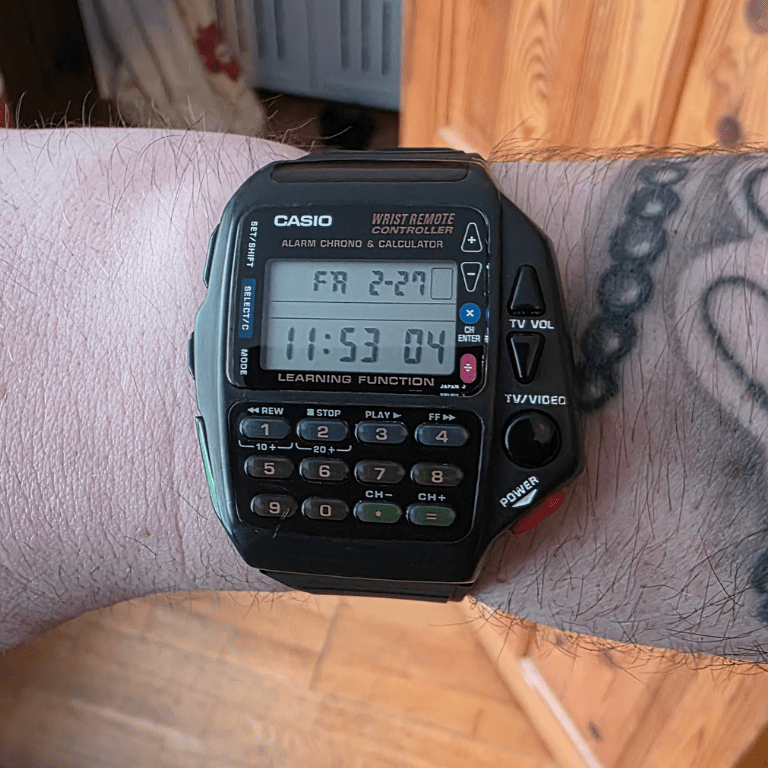
In the mid-1990s, Casio targeted teenagers and tech enthusiasts who wanted a unique gadget blending digital gaming with communication. The JG-100’s standout feature is its infrared (IR) transmitter and receiver, enabling watch-to-watch messaging and two distinct games. The Japanese Domestic Market (JDM) versions add a rare remote control function for TVs and VTRs, making this watch a cool collector’s item.
Quick Technical Data
| Parameter | Value |
|---|---|
| Model name | Casio JG-100 |
| Module number | 1268 |
| Battery | CR2032 |
| Manual | Download Casio JG-100 Manual (PDF) |
| Glass Type | Acrylic |
| Strap Lug Width | 18 mm |
| Strap Case Width | 23 mm |
| Color Versions | Purple-Arrow, Blue-Arrow (Infraceptor) |
| Special features | Infrared communication, two built-in games, 10-page databank, JDM remote control for TVs/VTRs |
Color Versions of Casio JG-100
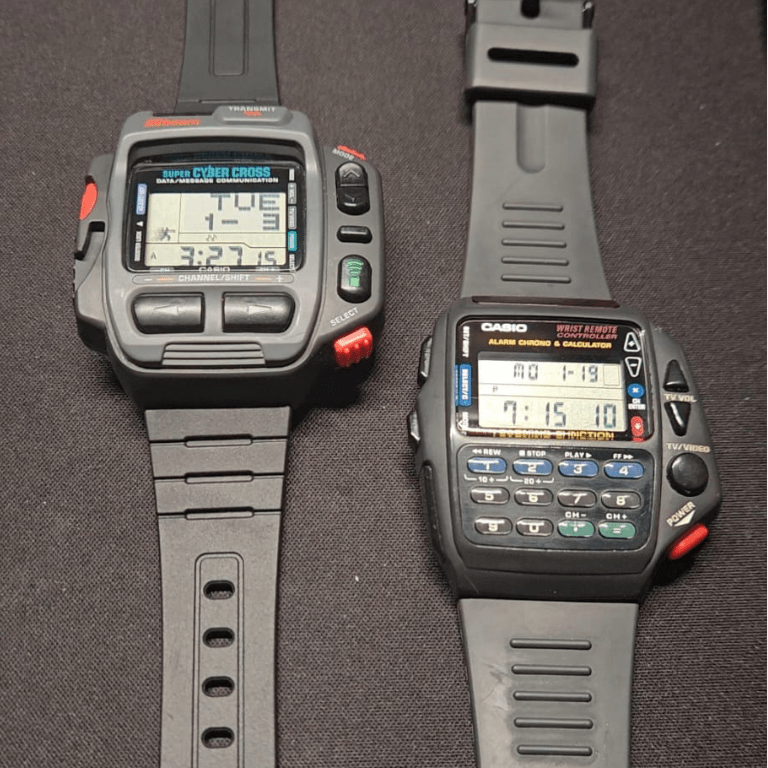
Two primary color variants exist: the Purple-Arrow Version with purple arrow buttons and green TRANSMIT button, and the Blue-Arrow Version (called Infraceptor) with blue arrow buttons and a yellow TRANSMIT button. Their case and bezel remain dark grey/black, but accent colors and top labels differ, reflecting regional or marketing variations.
Purple-Arrow Version
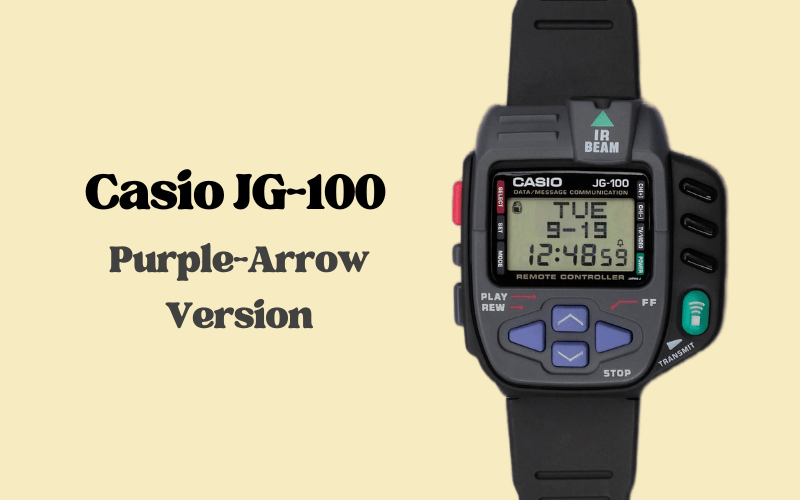
The Purple-Arrow version features purple arrow buttons, a red left-side function button, and a green “TRANSMIT” button on the right. The case and bezel are dark grey to black, with teal and red accent text. The top label reads “REMOTE CONTROLLER.”
Blue-Arrow Version (Infraceptor)
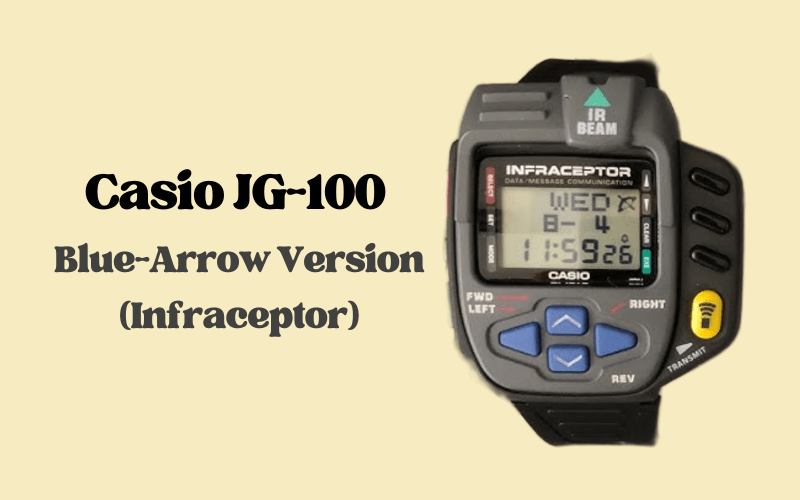
The Blue-Arrow edition, also known as Infraceptor, has blue arrow buttons, a red left button, and a yellow transmit button. The case and bezel remain dark grey/black but have white and yellow accent text. The top label displays “INFRACEPTOR.”
Both versions are rare and sought by collectors. The distinct button colors and label differences make each variant unique. Finding complete sets with original packaging and manuals adds extra collector value.
Features of Casio JG-100
Module 1268 powers multiple modes including timekeeping, games, databank, and communication. The databank can store up to 10 pages of names and numbers, a useful feature in the pre-smartphone era. Physical design-wise, the JG-100 is bulky and button-rich, with eleven buttons positioned for game control, messaging, and mode selection.
- Infrared (IR) communication for messaging and gaming
- Two built-in games: Tower Master Adventure and Magic Beam Battle
- 10-page databank to store names and phone numbers
- Loud daily alarm powered by two piezo springs, producing a very strong sound
- Stopwatch with up to 24 hours capacity; no sub-second timing
- Remote control function for TVs and VTRs (only on Japanese Domestic Market models)
- Vertical lug design for better comfort, especially on smaller wrists
- No backlight; watch is moisture resistant but not water resistant
Functions & Modes of Casio JG-100
- Main timekeeping mode with standard digital display
- Game mode accessed by pressing the red select button on the left side
- Beep sounds can be enabled or disabled in game mode via the “set” button below the select button
- Databank mode for storing names and numbers, with automatic alphabetical sorting
- Data communication mode for sending and receiving messages via IR; requires two devices in send/receive mode
- Remote control mode for TVs and VTRs, available only on JDM models
Casio JG-100 Manual
The manual to Casio JG-100 is available online:
How does the Tower Master Adventure Game work on Casio JG-100?
The Tower Master Adventure Game lets you play single-player or two-player mode against the watch’s CPU. You battle demons while climbing 10 floors of a temple. The gameplay involves using weapons—sword, bow and arrow, and lasso made of barbed wire.
The weapons follow a rock-paper-scissors style strength system: bow beats lasso, lasso beats sword, and sword beats bow.
If you lose multiple times, you are sent to an in-game jail for 60 minutes. You can escape by guessing a secret code.
To progress, you unlock gates by correctly arranging scrolling numbers using the transmit button. Three demons appear on specific floors: LEM on the 6th floor, RAD on the 8th, and ZEX at the top floor.
Defeating these demons requires matching their weak points with number sequences under time pressure. Successfully completing the game shows an orb symbol on the display.
What is the Magic Beam Battle Game on Casio JG-100?
The Magic Beam Battle is a multiplayer game played by connecting two JG-100 watches through infrared communication. Both players need to set their watches to send and receive modes and stay within about 15 feet.
This game requires good IR alignment and low ambient light for proper communication. It offers a unique competitive experience directly between two watch users, a cool feature ahead of its time.
Communication Features of Casio JG-100
The Casio JG-100 includes a built-in infrared (IR) sender and receiver. This allows watch-to-watch messaging and communication with Casio JD-6000 digital diaries. The effective IR range is about 15 feet, but it requires low ambient light conditions under 500 lux and no interference from other IR sources for reliable operation.
Export models use IR communication primarily for messaging and gaming. Japanese Domestic Market (JDM) models add a remote control function for TVs and VTRs. However, bright light and IR interference can limit communication success.
Display of Casio JG-100
The JG-100 has a small screen compared to its bulky case. It features two rows of dot matrix display centered and shrunk horizontally on the screen. This dot matrix area shows weapons and items during gameplay in the Tower Master Adventure and Magic Beam Battle games.
Below the dot matrix, a single row of standard 7-segment digital display shows the time and other basic data. Despite good contrast, there is no backlight, so viewing the screen is difficult in low light environments.
Physical Design of Casio JG-100
This watch has a large, bulky case due to the integrated IR module and extra buttons. There are 11 buttons in total: left side buttons control modes and settings, while the right side includes the prominent green “TRANSMIT” button used for IR messaging and game functions.
The watch uses a vertical lug design to better conform to various wrist sizes, including smaller wrists. The case and bezel are dark grey or black, with color accents depending on the version.
The original rubber strap often deteriorates over time, but a replacement strap from the popular Casio F-91W model fits well as a substitute. The side profile and thickness emphasize the chunky nature of the JG-100, making it stand out on the wrist.
Known Limitations of Casio JG-100
- The bulky and chunky design makes it less discreet and heavier than typical Casio models.
- The display is small relative to the watch body, reducing ease of reading.
- IR communication is limited by ambient light and distance; bright environments can block signals.
- Remote control functions only appear on JDM models and work best with 1990s CRT TVs, struggling with modern LCD or LED screens.
- There is no water resistance beyond moisture protection, so avoid aquatic use.
- Lack of backlight makes using the watch at night challenging without external light.
- Databank entry is slow and tedious due to the arrow button design.
- The stopwatch lacks sub-second precision, only measuring hours, minutes, and seconds.
- Battery replacement requires manual steps by the user; there is no automatic battery system.
- The Tower Master game is relatively simple and imposes a 60-minute jail penalty after repeated losses, though escape is possible with a code.
- The original rubber strap is prone to deterioration and often needs replacement.
Successors and Related Models to Casio JG-100
The Casio JG-100 is the first infrared game watch in the series. Its succesors are JG-200 and JG-10, an early IR concept watch with module 1403, a simple space shooter game, and a learning TV/VCR remote. The JG-10 was produced briefly and is extremely rare today.
After the JG-100 came the JG-200, which introduced an external battery-powered game module, making the watch larger and more experimental.
The line continued with the JG-300/310, released around 1996, which shifted to a more conventional game watch design similar to a G-Shock Frogman and included a boxing game with a comic booklet.
Casio discontinued the JG series after the JG-300/310, ending the era of IR game watches as handheld consoles became dominant.
FAQ – Casio JG-100
What are the main features of the Casio JG-100?
The Casio JG-100 includes infrared communication for messaging and gaming, two built-in games (Tower Master Adventure and Magic Beam Battle), a 10-page databank, daily alarm, hourly chime, and a loud alarm with dual piezo springs. It also has a vertical lug design for smaller wrists and a compact two-row dot matrix display.
How does infrared communication work on the Casio JG-100?
The watch uses a built-in IR sender and receiver to send and receive messages or game data with other JG-100 units or Casio JD-6000 digital diaries. Communication works up to about 15 feet indoors and requires low ambient light (under 500 lux) with no interference from other IR sources.
What games are included on the Casio JG-100 and how are they played?
It includes the Tower Master Adventure game, a single or two-player mode involving battles and floor climbing using rock-paper-scissors style weapons. The Magic Beam Battle lets two users compete via IR communication. Both games use the watch’s transmit button and arrow keys.
Does the Casio JG-100 have a backlight or water resistance?
No, the JG-100 has no backlight and requires external light to view the display. It is not water resistant, only moisture resistant, so it is not suitable for swimming or heavy exposure to water.
What are the differences between the JDM and export versions of the Casio JG-100?
JDM models are labeled REMOTE CONTROLLER and include remote control functions for CRT TVs and VTRs, plus they come with a screwdriver and spare battery. Export models, labeled INFRACEPTOR or later INFRABEAMER, focus on IR messaging and gaming without TV remote features.
Sources & Research for this article
The information needed to write this article about Casio JG-100 was gathered through hands-on research for CasioRestore.com. Sources include vintage Casio catalogs, Japanese blogs and archives (google.co.jp), old brochures, printed manuals, direct examination of real watches, and knowledge shared through conversations with collectors on Reddit, FB groups, and in private discussions.

Daniel is the person behind Vintage Casio Restore, a project dedicated to restoring and documenting vintage Casio digital watches from the 80s and 90s. Based in Poland, he combines technical precision with a passion for retro design, bringing forgotten models back to life and sharing their stories online.Outside the workshop, Daniel works in a digital agency, managing SEO and content strategy for technology clients, blending his professional experience with his love for classic tech and design.


Leave a Reply