
TL;DR
- Released in April 1993, the Casio BP-120 is a true vintage classic from the early 1990s.
- The main feature is health monitoring: it estimates blood pressure and pulse rate directly from your wrist.
- Unique for its time, the BP-120 uses both electro-potential and optical sensor technology.
- It requires personal calibration and can store up to 30 measurement records in memory.
- Collectors can find multiple color versions, including all-black “stealth” and a rare metallic style.
Casio BP-120 – Technical Data & Model Information
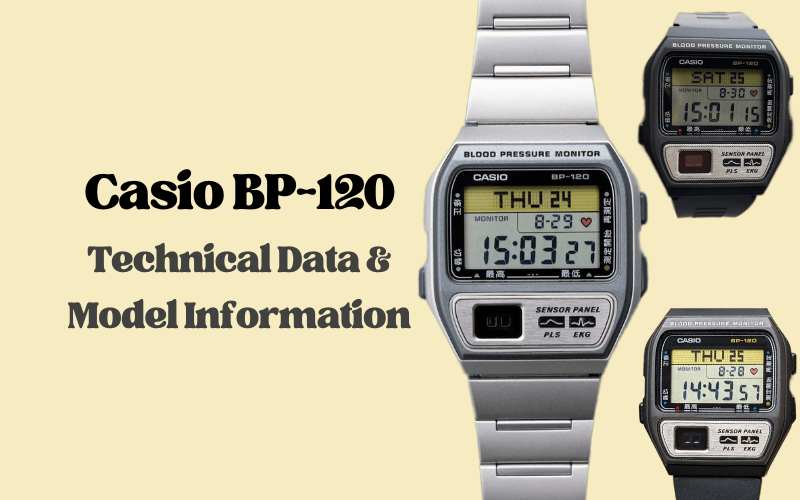
The BP-120 is the successor to the earlier BP-100, which was the first model in Casio’s blood pressure watch lineup. Compared to the BP-100, the BP-120 represents a second-generation design, with updated internal logic and improved measurement processing.
The watch supports cuffless blood pressure estimation and pulse measurement. It uses electro-potential sensors built into the case and an optical photosensor for fingertip pulse detection. Using this sensor data, the BP-120 estimates systolic blood pressure, diastolic blood pressure, and heart rate.
The BP-120 requires user calibration using a standard arm-type blood pressure monitor. After calibration, the watch can store up to 30 measurement records, each saved automatically with date and time.
In addition to health functions, the BP-120 includes standard digital watch features such as timekeeping, alarm, and memory recall. The model was produced in multiple color variants and is now mainly of interest to vintage Casio collectors and enthusiasts of early wearable health technology.
Quick Technical Data
| Parameter | Value |
|---|---|
| Model name | Casio BP-120 |
| Module number | QW-1101 |
| Battery | CR2016 |
| Glass Type | Acrylic |
| Strap Lug Width | 19–20 mm |
| Strap Case Width | 23–24 mm |
| Manual | Casio BP-120 / Module 1101 Manual (PDF) |
| Color Versions | Full Black Version (Black Button), Black Version with Yellow Button and Red Border, Full Black Version with Yellow Button, Grey Top Case with Yellow Button, Silver Case with Steel Bracelet |
| Special / unique features | Second-generation wearable blood pressure and pulse measuring watch. 30-record memory for pulse and BP readings. Battery low warning and calibration-dependent measurements. No display backlight. |
| Production years | April 1993 start (JDM), further years Unknown |
Color Versions
Full Black Version (Black Button)
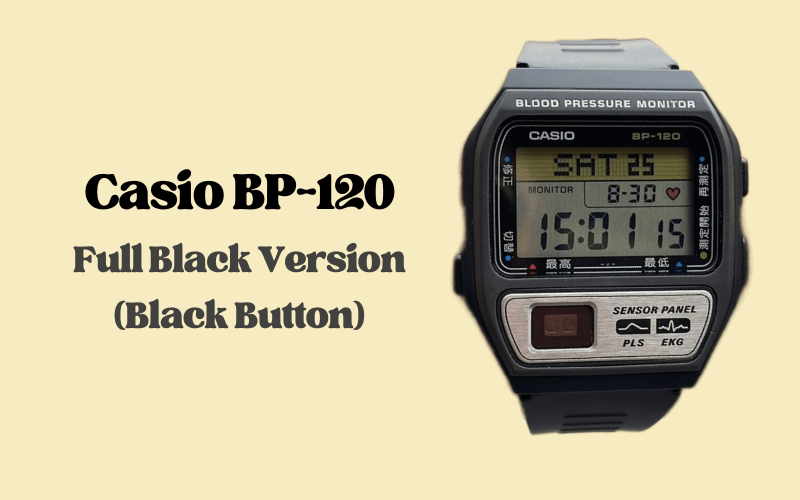
All-black case, black side button, and zero color accents. This is the most uniform and stealthy BP-120 variant for collectors who love low-key retro.
Black Version with Yellow Button and Red Border
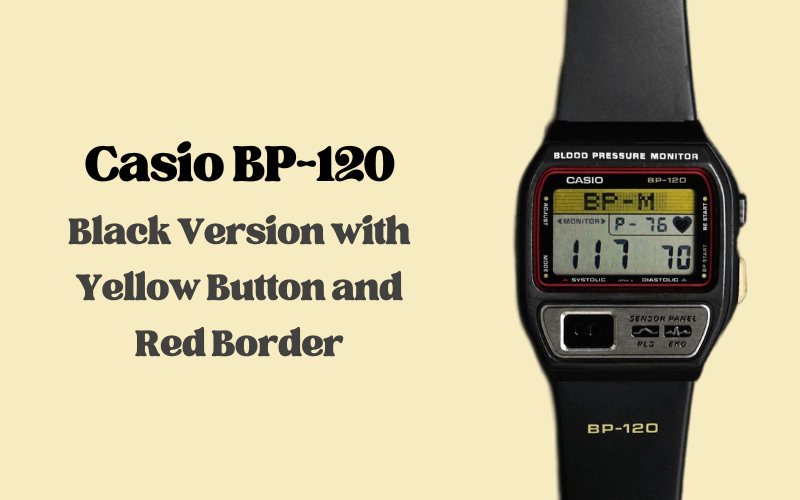
Black case with a bright yellow side button and a red border outlining the display. The most visually sporty and high-contrast option from the BP-120 lineup.
Full Black Version with Yellow Button
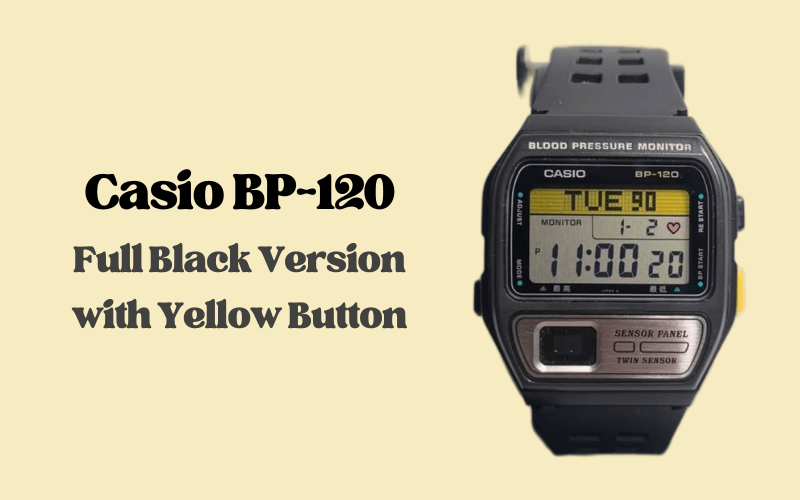
Entirely black case paired with a yellow side button, but no red border. This variant looks more subtle than the “red accent” version—just a touch of color without extra flash.
Grey Top Case with Yellow Button
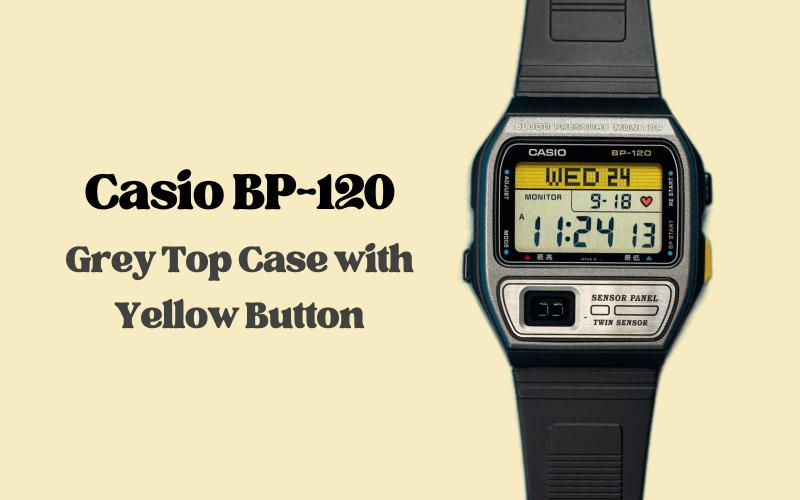
Upper part of the case in grey, yellow side button, and the bottom case and strap in black. This is the only two-tone BP-120 style, standing out for its distinctive color split.
Silver Case with Steel Bracelet
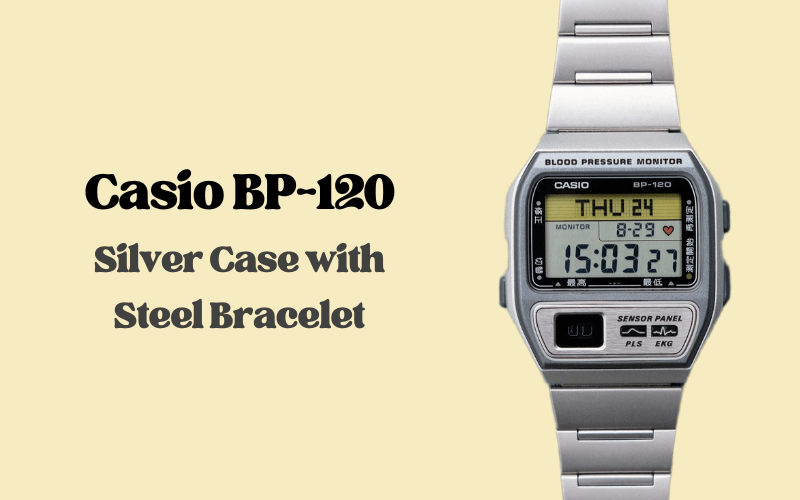
Galvanized silver case and a steel bracelet, without colored buttons. The most metallic and elegant BP-120—a rare sight and favorite for anyone seeking a unique hybrid of tech and dress style.
Features of the Casio BP-120
The Casio BP-120 stands out as an early wearable health device with several intriguing features. It estimates blood pressure by recording both systolic and diastolic values, as well as measuring your pulse rate. Using electro-potential sensors, it detects electrical activity from your body for its readings. Readings and status messages display on a segmented LCD screen, including text like “RETRY,” “ERROR,” and “BATT!”
The watch stores up to 30 sets of measurements, each with automatic date and time stamps. This memory system allows you to track trends or spot irregularities over time. Besides its medical-related functions, the BP-120 includes basic alarm and timekeeping modes. Error detection is built in—the system can prompt you to retry if it detects movement or poor contact during measurement. Calibration is required and involves entering your own reference data to ensure more accurate results.
Casio BP-120 Manual
The official Casio BP-120 manual for module 1101 is available on the CasioRestore.com drive:
How does Functions & Modes work on the Casio BP-120?
The Casio BP-120 operates through several specialized modes. The blood pressure measurement mode requires the watch to be worn on your left wrist and your right-hand finger placed correctly and held still. Accurate results depend on calmness and proper contact with the sensors. There is an alarm mode for basic reminders and a standard timekeeping function, though detailed settings aren’t documented in user reports.
Stored measurements can be recalled through a dedicated memory recall mode. The watch uses clear status and error messages—“RETRY” appears if your finger loses contact, pressure is off, or your hand moves. “ERROR” shows when calibration data is missing or there’s a logical issue with the input. Calibration itself is a separate mode, requesting two sets of personal data: at-rest and after light exercise. This setup is crucial for the device to estimate your blood pressure using internal calculations.
Physical design of the Casio BP-120
The BP-120 is built with a lightweight plastic case and features an acrylic glass face. The case back acts as the main electro-potential sensor (positive terminal), making solid skin contact essential for any measurement. The front sports an additional electro-potential sensor (negative terminal) specifically for finger contact during use, plus a photosensor that detects the pulse wave under your finger pad.
The original resin strap is now rarely found intact and was designed to hold the watch snugly on the left wrist. The strap lugs measure 19–20 mm in width, while the main body is 23–24 mm across. Using the BP-120 correctly means wearing it on your left wrist and pressing your right-hand finger pad—lightly, not forcefully—against the front sensor for a steady reading. The unique sensor arrangement is key to this model’s early-1990s health tech identity.
What are the Known Issues / Limitations of the Casio BP-120?
The BP-120 does not directly measure blood pressure. Instead, it uses internal Pulse Wave Transit Time (PWTT) calculations, so results rely heavily on correct calibration and precise finger placement. Accuracy can suffer if you move during measurement, place your finger incorrectly, or skip calibration. The display has no backlight, so using it in the dark is difficult.
Another limitation—changing the battery disables blood pressure measurements until you recalibrate the watch. It can be frustrating to see “RETRY” or “ERROR” messages appear often if your technique or setup is off. Calibration requires an external arm-type blood pressure monitor, adding an extra step to setup. Memory is limited to 30 results; once full, the oldest data gets overwritten. There is no way to sync data to other devices, and the BP-120 is not considered medical-grade. Collectors generally enjoy it as an experimental, nostalgic Casio, not a reliable health tool.
What are the Successors / Related Models of the Casio BP-120?
The BP-120 is the direct successor to the pioneering BP-100. It represents the second-generation design in Casio’s blood pressure series. Later and rarer models in this family include the BP-300 and BP-400, though these are very hard to find today.
FAQ – Casio BP-120
How accurate is the blood pressure measurement on the Casio BP-120?
The Casio BP-120 offers blood pressure readings using Pulse Wave Transit Time and user calibration data. Its accuracy depends on careful calibration, correct finger placement, stillness, and proper use. It is not a medical-grade device and should not be relied on for clinical decisions.
What calibration steps are required for the Casio BP-120?
To calibrate the BP-120, users must enter two sets of “Basic Data”: one at rest and one after exercise. Accurate calibration needs an external arm-type blood pressure monitor and a 3-minute stepping exercise to gather reference values.
Can the Casio BP-120 be used as a medical device?
The Casio BP-120 is an experimental wearable health device and is not intended for medical use. Its results can vary, and it should not replace professional medical equipment or advice.
What are the differences between the color versions of the Casio BP-120?
Five official versions of the BP-120 exist, including a full black “stealth” model, a black version with a yellow button and red border (sporty look), a black with yellow button version (no red), a grey top with yellow button (two-tone), and a rare silver case with steel bracelet (most elegant).
How does the Casio BP-120 detect pulse and blood pressure without a cuff?
The BP-120 uses optical sensors and electro-potential contacts: the case back contacts the left wrist, and the user places a right finger on a front sensor. It estimates blood pressure and pulse using internal calculations based on pulse wave transit time (PWTT).
Sources & Research Notes
The information needed to write this article about Casio BP-120 was gathered through hands-on research for CasioRestore.com. Sources include vintage Casio catalogs, Japanese blogs and archives (google.co.jp), old brochures, printed manuals, direct examination of real watches, and knowledge shared through conversations with collectors on Reddit, FB groups, and in private discussions.

Daniel is the person behind Vintage Casio Restore, a project dedicated to restoring and documenting vintage Casio digital watches from the 80s and 90s. Based in Poland, he combines technical precision with a passion for retro design, bringing forgotten models back to life and sharing their stories online.Outside the workshop, Daniel works in a digital agency, managing SEO and content strategy for technology clients, blending his professional experience with his love for classic tech and design.

Leave a Reply