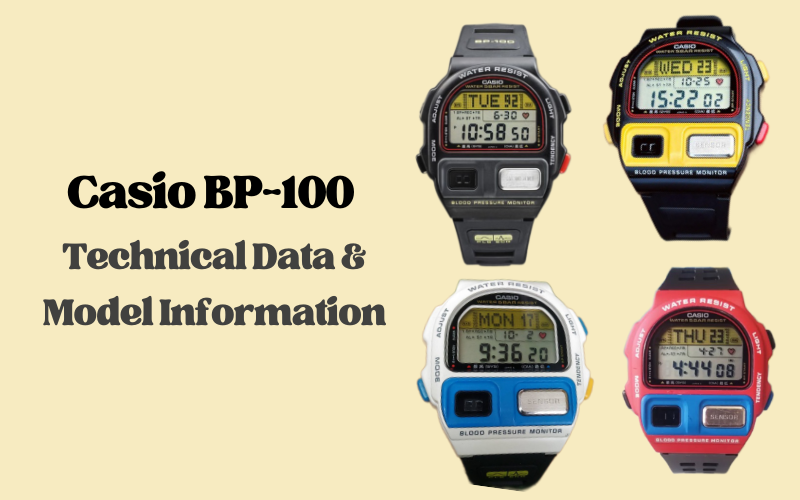
The Casio BP-100 is a digital wristwatch released around 1991 by Casio. It is the first model in Casio’s Blood Pressure (BP) series and the company’s first watch capable of measuring blood pressure and pulse.
The BP-100 operates on module 900 and uses a fingertip sensor plate to detect vital signs. The measurement system relies on electro-potential sensing and early pulse detection methods to estimate blood pressure and heart rate directly from the wrist and finger contact. This technology was highly experimental for the early 1990s and required careful finger placement and stillness.
In addition to its health-monitoring function, the BP-100 includes standard Casio digital features such as dual alarms, stopwatch, countdown timer, and full time and date display. These functions make it usable as an everyday digital watch despite its experimental focus.
The Casio BP-120 was later introduced as the direct successor to the BP-100. It represents a second-generation design with updated measurement logic and a more advanced calibration system. Today, the BP-100 is mainly valued for its historical importance as one of the earliest wearable blood pressure devices produced for consumers.
Casio BP-100 – Quick Technical Data
| Field | Data |
|---|---|
| Model | Casio BP-100 |
| Module | 900 |
| Battery | CR2016 |
| Manual | Casio BP-100 Manual PDF |
| Glass Type | Acrylic |
| Strap Size | 17 mm (lug) / 23 mm (case) |
| Case Material | Resin (with rare stainless steel version) |
| Functions | Blood pressure & pulse measurement, dual alarms, stopwatch, countdown timer, time/date |
| Production Years | c. 1991–early 1990s |
What color versions of Casio BP-100 exist?
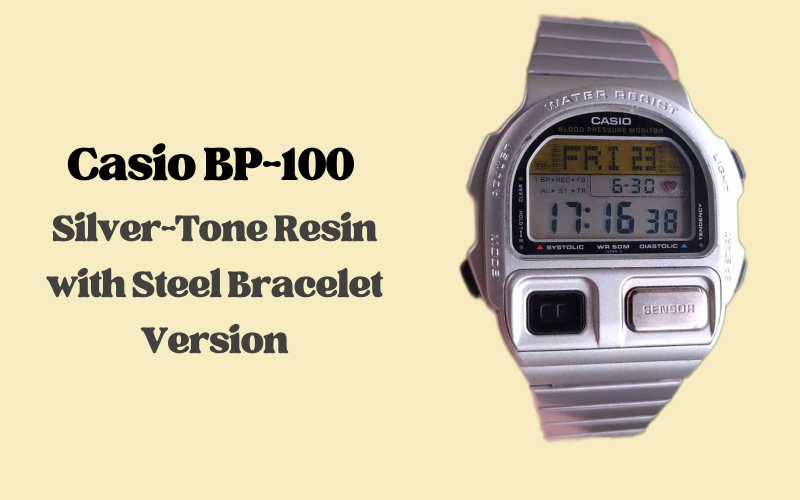
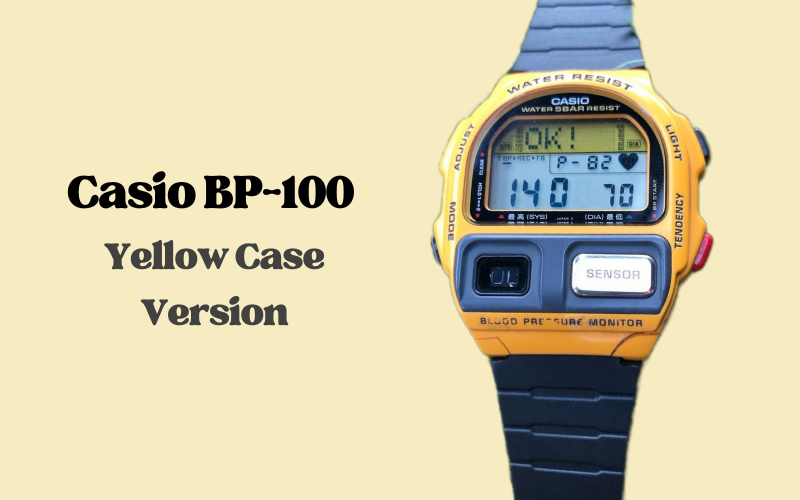
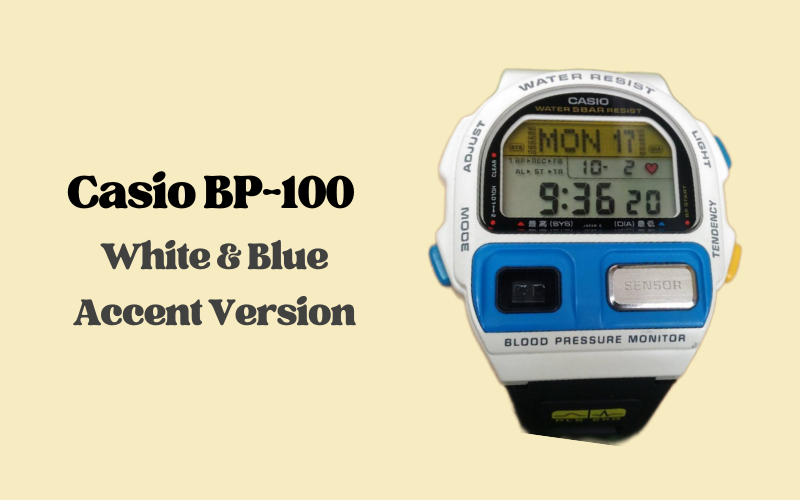
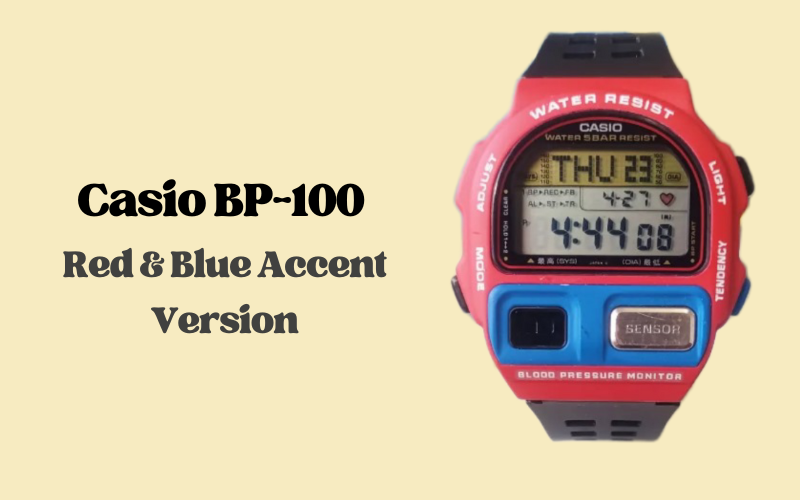
Casio BP-100 was released in several versions: the classic black resin model was the most common, while other editions included black with yellow accents, black with blue accents, silver-oone resin with steel bracelet, yellow case, red with blue details, and the white with baby blue accent version. Among these, the white/blue model is considered one of the rarest today.
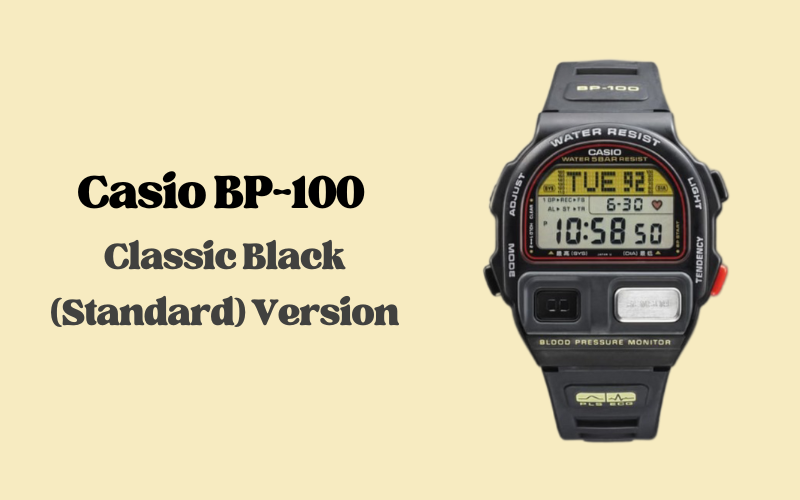
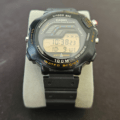
- Classic Black (Standard) – black resin case and strap with yellow “BLOOD PREASSURE MONITOR” text. Simple and professional.
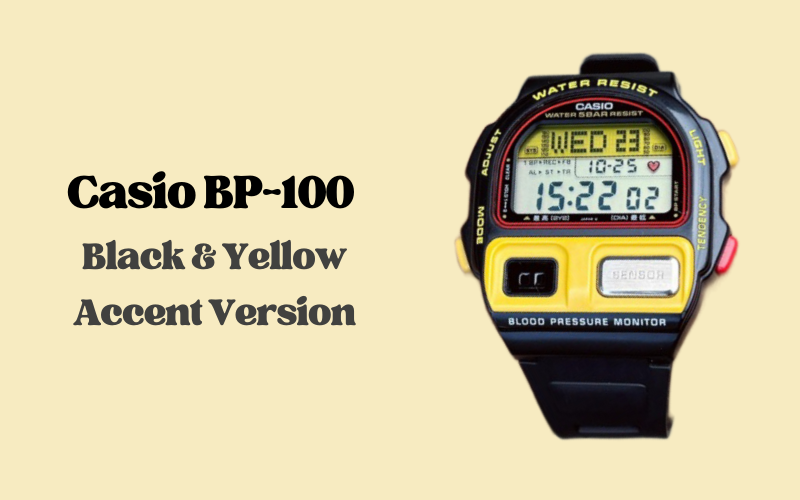
- Black & Yellow Accent – black case with bright yellow highlights around the display and buttons. Sporty look.
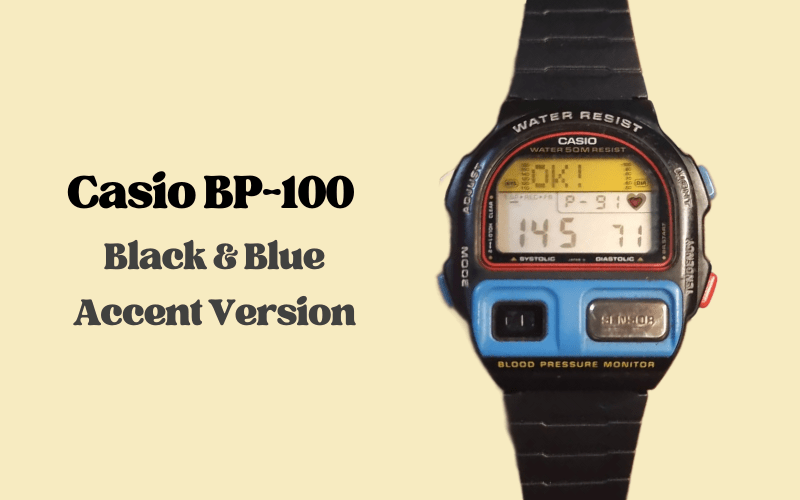
- Black & Blue Accent – black resin case with vibrant blue highlights around the buttons and display bezel.
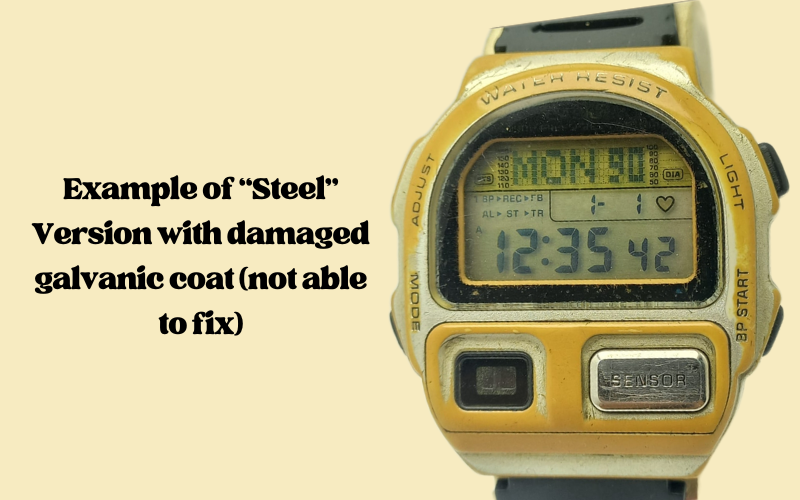
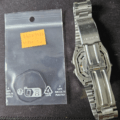
- Silver-Tone Resin with Steel Bracelet – Resin case covered with a thin galvanic metal coating, paired with a stainless steel bracelet. The case only looks metallic; with wear the coating rubs off, leaving the beige resin underneath. Because of this, many surviving pieces are in poor condition, and the coating cannot be repaired. This version is rarer than the standard black resin models.
- Yellow Case – yellow resin case, black letters. Playful and bold.
- White & Blue Accent – white case with blue sensor accents, black strap. Uncommon to see today.
- Red & Blue Accent – red case with blue highlights, black strap. Very retro 90s sports vibe.
Features & Functions of Casio BP-100
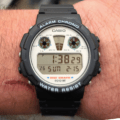
Casio BP-100 combined everyday watch features with experimental medical technology. It could measure blood pressure and pulse using a fingertip sensor on the watch face, while still offering Casio’s standard digital functions.
- Health functions: blood pressure measurement, pulse sensor, graph display, flashing heart icon during readings.
- Basic functions: dual alarms, stopwatch, countdown timer, 12/24-hour time, calendar.
- Usage tips: the watch must be worn on the wrist to work correctly, and Casio recommended leaving it on for 10–15 minutes before measuring so the plate warms up.
- Quirks: the watch often displayed “ERROR” messages if the sensor didn’t get stable input, something collectors still encounter today.
💡 Collector Tip – Sensor & ERROR messages
Inside the back cover there are two springs. One is for the buzzer, the other for the sensor. Many collectors lose the small sensor spring when changing the battery, and then the BP function never works again.
The watch must also be worn on the wrist to work correctly, and Casio recommended leaving it on for about 10–15 minutes before taking a reading so the plate warms up. The “ERROR” message can appear not only from unstable input but also from placing fingers incorrectly on the sensors.
After checking the spring is in place and wearing the watch on the wrist, it often helps to experiment with finger positioning to get a proper reading.
Collectibility & Quirks of Casio BP-100
Casio BP-100 is a watch that many collectors look for because of its mix of health gadget and digital watch. It was special in the 90s and it is still special today.
What you can find today:
- The black resin model is the most common.
- The so-called “steel” version is not real steel. The case is resin with a shiny coating, and only the bracelet is stainless steel. With age the coating comes off, the beige resin shows, and this cannot be repaired. These are often found in bad condition on auctions.
- Other colored versions are harder to see.
- The white with baby blue model is the rarest of all.
Things that often go wrong:
- Resin lugs break easily.
- Strap print fades over time. Most watches no longer have the “blood pressure monitor” text visible.
- Sensors stop working with age.
For collectors, the most valuable finds are those with the original strap with “BP-100” text still visible, and even more rare when the original box is included. Such sets are much harder to find and usually cost more.
Casio BP-100 – Manual
Collectors are lucky that the original documentation for the BP-100 survives. Casio provided a detailed manual and even marketed the watch in catalogs as part of their “Health & Medical” line.
Manual: Casio BP-100 Instruction PDF
FAQ – Casio BP-100
What battery does Casio BP-100 use?
Casio BP-100 uses a CR2016 lithium coin battery.
Is Casio BP-100 water resistant?
It was sold as splash resistant, but remember this is a very old watch. The gaskets may no longer work well, so it is best not to expose the BP-100 to water.
How rare is Casio BP-100 today?
The black resin version is the most common. Stainless steel and colored versions are much harder to find, and the white with baby blue model is one of the rarest.
Where can I find a strap replacement for Casio BP-100?
Original straps are very hard to find. Some collectors fit modern 17 mm straps, but they do not look the same. The original strap with printed text is a big part of the watch’s character.
Does Casio BP-100 still work with its blood pressure function?
Some watches still work, but many show “ERROR” because of old sensors or missing springs inside. Even if it works, results are not reliable for medical use today.
How can I fix the “ERROR” message on Casio BP-100?
Make sure the watch is worn on the wrist and warmed up for 10–15 minutes before taking a reading. Check that both springs under the caseback are in place: one for the buzzer and one for the sensor. If the sensor spring is missing, the BP function will not work. Clean the sensor plate carefully, as dirt or oxidation can also cause errors.
Passionate about Casio’s golden-era digital watches. At Vintage Casio Restore, I bring old models back to life and share practical guides for collectors and enthusiasts.


Leave a Reply