Introduction
White plastic looks great on vintage Casio watches. When it is new 😅 After many years, sunlight slowly turns it yellow. This is a very common problem on older Casio models with white dials. The watch can be fully working, but the yellowed watch face makes it look tired and neglected.
In this project, I focus only on whitening a yellowed watch face. The part was originally white, but long-term UV exposure changed its color. This happens often and collectors see it all the time, especially on rare white versions. Finding these parts in good condition is getting harder every year.
I used a whitening method I already tested on previous restorations like the DBF-50W and TS-200. Those projects showed me that this technique can safely restore white plastic when used with care.
Because many collectors ask about this process, I decided to show it step by step. The goal is simple: bring the plastic back as close as possible to its original white, without repainting, without replacing parts, and without losing originality.
How Is the TGW-10 Faceplate Mounted?
Before whitening, I had to remove the faceplate safely 🔧. This step is important. Do it wrong and you can crack the plastic.
The Casio TGW-10 faceplate is fixed to the case with four small plastic contact points. Think of them like tiny plastic welds. There are no screws. Casio did this a lot in the 90s.
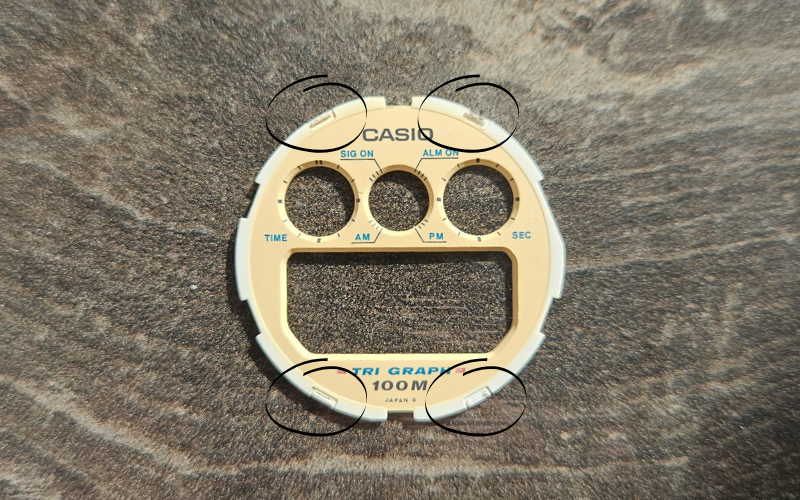
First, I opened the case back. Next, I removed the module. After that, the faceplate was fully accessible from the inside.
To remove it, I gently pried the faceplate from each side. Slowly. With feeling. I did not force it in one place. The goal is to slowly break the plastic contact points one by one. You will feel when it lets go 👍.
This part always feels scary the first time. Every collector knows this moment 😅. But don’t worry. Once removed, the faceplate can be mounted back later without problems. When you place it back in position and install the module, everything fits tight again. Nothing moves. Nothing rattles.
With the faceplate finally out, I could move on to the whitening process 🛠️.
Watch Dial Whitening process – step by step
This is the key part of the restoration 🛠️. The goal was to remove the yellowing and bring back the original white color, without damaging the plastic.
Materials I Used
- Plastic food wrap
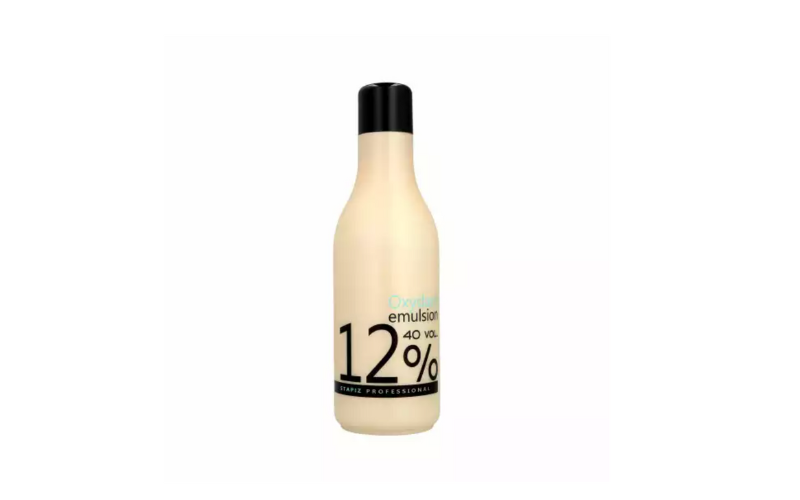
- Stapiz Oxydant 12%
- Disposable gloves
I use Stapiz Oxydant 12% because it works well on old Casio resin. You can buy it on Amazon or in a local hair supply shop. Do not use stronger solutions. Stronger does not mean better here.
Whitening Process
First, I placed the faceplate on a piece of plastic wrap.
Next, I applied a thick and even layer of oxydant on the yellowed areas.
After that, I wrapped everything tightly in the plastic wrap. This is important. The oxydant must not dry out.
Then I placed the wrapped faceplate near a window, in direct sunlight ☀️. UV light is required. Without UV, the oxydant will not work.
I left it there for about 3–4 hours. Strong sun gives faster results. I checked it from time to time, but I did not unwrap it during the process.
When the whitening was done, I unwrapped the faceplate and rinsed it with water. I wore gloves the whole time. Oxydant is corrosive, and skin contact is not a good idea 😅.
After rinsing, I let the faceplate dry completely. Only then it was ready for reassembly.
When Does This Method Work — and When Should You Avoid It?
This whitening method works well, but only in specific cases. This is very important to understand.
I use this process only on white Casio plastics. It also works a little on light grey resin, but you must be very careful with time and UV exposure. I tested this before on other projects, like Casio DBF-10 (read my restoration on Casio DBF-50W below) and short exposure was the key.
Do not use this method on colored plastics. Pink Casios that turned orange will not return to pink. Blue, red, or green resin will lose pigment. The color breaks down and becomes pale or almost white 😅. This damage is permanent.
This happens because the oxydant attacks the remaining pigment inside the plastic. Once the pigment is gone, there is no way back. No polishing. No dye. Nothing.
That is why I always say this clearly. This method is safe for white faceplates only. For rare color versions, do not experiment. As collectors, we want to preserve history, not destroy it 🛠️.
Final Result – Bringing the White Back
After the faceplate was fully dry, I placed it back into the case 🔧.
Next, I installed the module. The pressure from the module locks the faceplate in place. Just like from factory. Nothing moves. Nothing rattles 👍.
The result was exactly what I wanted. The yellow tone was gone. The original white color came back. The faceplate looks clean and sharp again.
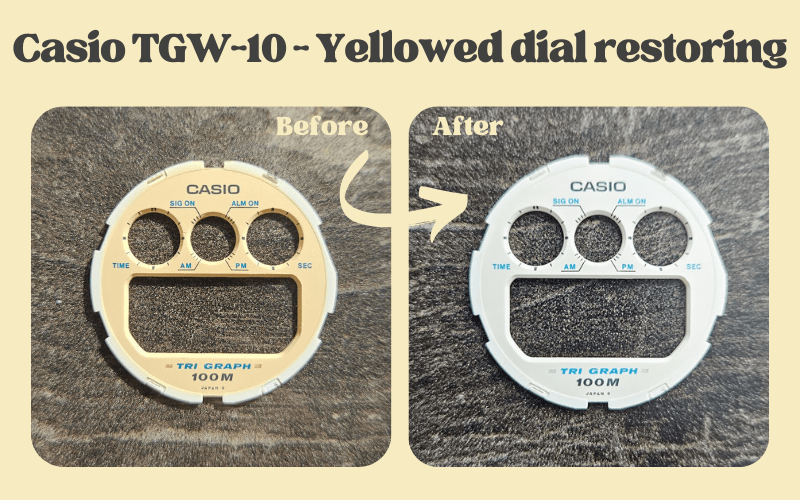
This is the kind of difference collectors notice immediately 😅. The watch looks younger. More correct. More “Casio”.
This method saved an original Casio TGW-10 white faceplate that would otherwise stay yellow forever. For rare color versions, this makes a big difference.
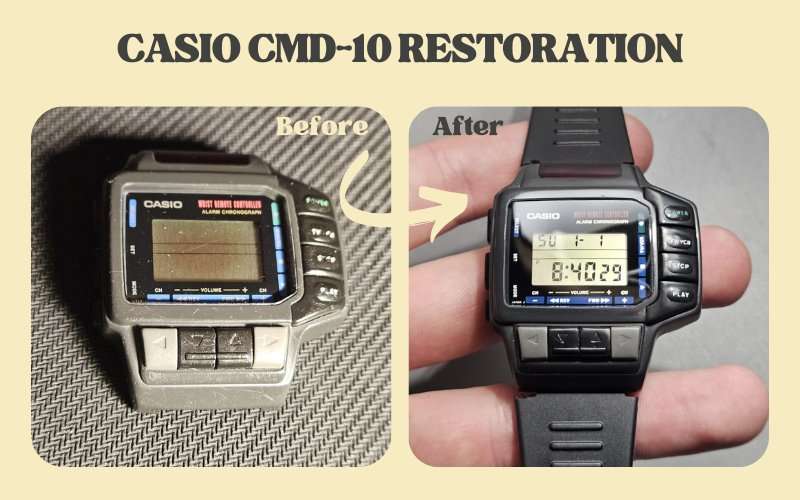
If you collect white Casios like TS-200, DBF-50W, or CMD-10, you know how important this is 🛠️.

Daniel is the person behind Vintage Casio Restore, a project dedicated to restoring and documenting vintage Casio digital watches from the 80s and 90s. Based in Poland, he combines technical precision with a passion for retro design, bringing forgotten models back to life and sharing their stories online.Outside the workshop, Daniel works in a digital agency, managing SEO and content strategy for technology clients, blending his professional experience with his love for classic tech and design.


Leave a Reply